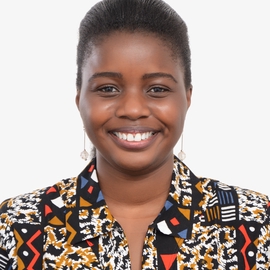
Lydia Nishimwe
AI Research Scientist | PhD
Biography
AI Research Scientist working on large-scale Transformer models, with a focus on how they behave under distribution shift and how to make them more robust to real-world data.
I completed my PhD at Inria Paris and Sorbonne Université, where I studied the interaction between data, scale, and model behaviour in neural systems, from representation learning to generation.
My work sits at the intersection of model design, evaluation, and real-world reliability, with a particular interest in understanding and improving how AI models generalise beyond clean benchmarks.
Beyond research, I enjoy writing, public speaking, and exploring languages and cultures.
Currently exploring research scientist and applied AI roles.
Nishimwe (/niːʃiːmŋé/) is a Rwandan name meaning ‘Thanks be to God.'
Fun fact: there is another Lydia Nishimwe who is a singer—we are not related.
- LLMs & Foundation Models
- Representation Learning
- Robustness, Evaluation & Distribution Shift
- Multimodality & Multilinguality
-
PhD in Computer Science, 2021-2025
Inria Paris, Sorbonne Université
-
MEng in Mathematics and Computer Science, 2017-2021
École Centrale de Nantes
-
BSc in Mathematics and Computer Science, 2014-2017
Université Grenoble Alpes
Languages

Native

Native

Advanced

Intermediate

Intermediate

Elementary
Experience

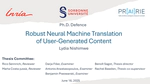
Topic: Robust Neural Machine Translation of User-Generated Content
Supervised by Benoît SAGOT and Rachel BAWDEN, defended on June 18, 2025
- Designed and trained large-scale Transformer models (100M–1.3B parameters) for multilingual representation learning and generation.
- Studied how performance evolves under data scale, noise, and distribution shifts, using datasets from thousands to hundreds of millions of samples.
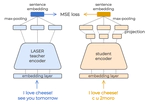
- Developed robust representation learning approaches, aligning noisy and standard inputs to improve generalisation.
- Explored trade-offs between normalisation, robustness, and semantic preservation using BERT-style models and LLMs.
- Fine-tuned multilingual models on real-world data, demonstrating robustness gains without sacrificing standard performance.
- Analysed scaling effects, showing that larger models reduce sensitivity to surface noise but introduce new distribution-related failure modes.
- Framed robustness as learning across heterogeneous data distributions, with implications for real-world and multimodal AI systems.
Tech stack: Python, PyTorch (Fairseq, Hugging Face Transformers), Pandas, Scikit-Learn, SLURM

- Studied sequence generation strategies, analysing trade-offs between quality, latency, and search complexity.
- Designed controlled experiments to isolate decoding behaviour from model architecture.
- Identified key failure modes in neural generation, shaping an interest in evaluation and reliability of generative models.
Tech stack: Python, TensorFlow, Keras, Pandas, Scikit-Learn

- Integrated an external LMS (Opencast) into a production platform, focusing on API reliability and data flow across services.
- Worked on backend systems in Erlang, gaining early exposure to distributed system interactions.
Tech stack: Erlang, HTTP

Topic: Functional verification of an ARM7 microprocessor
- Verified and debugged an ARM7 microprocessor using VHDL simulations and assembly-level test programs.
- Investigated execution behaviour (pipeline hazards, instruction decoding), developing an early focus on system correctness and reliability.
Tech stack: VHDL, C, ARM Assembly, ModelSim
🏆Stage d’excellence (Excellence Internship Program) - Université Grenoble Alpes🏆

- Modelled and simulated GPS trajectories using synchronous functional languages (Lustre, Lutin).
- Worked on temporal system behaviour, introducing a formal and structured approach to modelling and reasoning.
Tech stack: Lutin, Lustre
🏆Stage d’excellence (Excellence Internship Program) - Université Grenoble Alpes🏆